An In-Depth Look: How Much Should a New Small Business Really Budget for Marketing in 2026?
One of the most common questions new business owners (especially new solopreneurs) ask us is: "How much do I need to spend on marketing?"
The honest answer is … more than most people expect, less than most people fear, and far less than what it costs to ignore it.
Whether you're launching your first business or you're a few years in and realizing your marketing hasn't kept up with your ambitions, this guide will give you real numbers from credible sources and show you why a professional agency approach is often the smartest and ultimately most affordable path forward.
What the Data Actually Says
For new and emerging businesses — those in their first one to three years, still building brand awareness, still earning trust — the U.S. Small Business Administration (SBA) and other major research bodies consistently recommend spending a minimum of 10–20% of projected revenue.
For smaller companies with under $10 million in revenue, research from TrueFuture Media and other industry analysts shows budgets averaging closer to 15% of revenue, precisely because smaller businesses can't rely on brand recognition the way established players can.
In real dollar terms? Most sources, including WebFX and multiple industry surveys, peg the average small business at spending $10,000 to $50,000 per year on marketing. Intuit's 2025 research puts the average estimated advertising budget for a small, established business even higher — at $78,000 annually.
For pre-revenue businesses or those in their very first year, rather than a percentage of revenue you don't yet have, industry experts generally recommend a minimum annual marketing investment in the range of $8,000–$15,000 to establish a meaningful presence, with the expectation that spend grows as revenue does.
"Marketing isn't an expense — it's an investment, one that drives your sales. Without marketing, you won't reach new potential customers, and that could mean lower sales."
— U.S. Small Business Administration
Why New Businesses Need to Spend More — Not Less
It's tempting to think that a brand-new business should spend conservatively until it "proves itself." This logic is backwards, and the data backs that up.
Established businesses have something new businesses don't: momentum. They have reviews, word of mouth, repeat customers, and search engine authority built up over years. A new business has none of that. Every customer you acquire has to be earned from scratch — through visibility, credibility, and consistency. That costs more per customer at first, and that's normal.
Think of it this way: an established restaurant doesn't need to advertise the fact that it exists. A brand-new one absolutely does.
The Painful Truth About Under-Investing in Marketing
Research from multiple sources, including Harvard Business Review, consistently shows that businesses that maintain or increase marketing spend during difficult periods recover faster and gain market share while competitors pull back.
On the flip side, businesses that underspend on marketing report slow growth, poor brand awareness, and missed sales opportunities. The "I'll market more when I make more money" mindset is a trap, because without marketing, the revenue growth that would fund more marketing never comes.
According to survey data compiled by RevenueMemo (2026), small businesses with a marketing plan are 6.7 times more likely to report success than those operating without one.
The Reality Gap: What Businesses Should Spend vs. What They Actually Spend
Despite clear guidance from the SBA and industry experts, the gap between what small businesses should spend on marketing and what they actually spend is enormous.
According to data compiled in 2026 research, 66.3% of small business owners spend less than $1,000 per year on marketing. A 2023 survey by The Manifest found that the average small business spends just $534 per month — or about $6,400 annually.
That's not a marketing budget … that's a marketing afterthought.
This gap is not because business owners don't value marketing. It's because they're stretched thin, time is short, and the complexity of modern marketing — SEO, AEO (AI Engine Optimization), social media, email, content, paid ads — can feel overwhelming. So they dabble instead of committing. And dabbling rarely produces results worth writing home about.
The DIY Marketing Trap
For some very early-stage, time-rich solopreneurs, DIY marketing is a legitimate starting point. But for most business owners — especially those running operations that actually demand their attention — DIY marketing has real hidden costs that rarely get accounted for.
Your time has value. If you're spending 10 hours a week trying to figure out Instagram algorithms, write blog posts, manage your Google Business Profile, and respond to reviews, then that's 10 hours not spent serving clients, improving your product, or building your business. For many owners, that time is worth $50–$150 an hour or more.
The harder truth is that inconsistent, piecemeal marketing doesn't just fail to help; it can actively hurt your business. Neglected email list subscribers, sporadic social posts, no consistent feed of fresh content on your website, and no overall SEO/AEO strategy all signal to potential customers (and search/answer engines) that your business isn't active or serious.
People turn away from businesses that look low-activity, no matter how good the underlying product or service is. Wouldn’t you?
Agency vs. In-House: What the Numbers Actually Say
Many business owners assume the real choice is between DIY and "hire someone full-time." But for most small businesses, there's a smarter middle path: a professional marketing agency. Here's what the cost comparison actually looks like:
The Real Cost of an In-House Hire
According to Glassdoor data cited in a 2025 industry analysis, the average Digital Marketing Specialist in the U.S. earns $70,473 per year in base salary alone. Once you factor in employer-side taxes, health benefits, paid time off, recruitment costs (averaging $4,700 per hire), onboarding, and the software and tools they'll need, the fully loaded annual cost of a single mid-level marketing employee often runs $85,000–$100,000 or more.
A marketing manager — someone who can actually lead and direct — commands considerably more. Industry data puts the average marketing manager salary at around $120,000 per year before overhead.
It’s smart to compare the options:
In-House Hire
$70K–$120K+ base salary for one person
$85K–$150K+ fully loaded annual cost
$4,700 average recruitment cost per hire
44-day average time-to-fill the role
6–10 weeks of onboarding before real productivity
Usually an expert in only 1–2 marketing areas
Employee turnover costs 50–200% of salary to replace
You manage them; their problems become your problems
Professional Agency
Typically $2,000–$15,000/month for full-service
Multi-service options: SEO, content, social, strategy, analytics
No recruitment, onboarding, or HR overhead
Built-in expertise across all major channels
Scales up or down with your needs and budget
No turnover risk
You focus on your business; they handle marketing
As a 2025 analysis by MarketerHire noted, agencies typically charge small businesses $5,000–$15,000 monthly retainers and cover teams of specialists without any of the salary overhead, turnover risk, or tool costs you'd absorb in-house. As one industry source put it plainly: "It's access to experts for less than the cost of hiring one employee."
How Austen Agency's Rates Compare
We want to be direct about something: our rates are genuinely competitive, especially for the scope and quality of what's included.
Our Marketing Essentials Package — which bundles 7 absolutely essential marketing services into one coordinated, year-long program — starts at under $4,500/year for our Basic level, with professional-level plans available for under $25,000/year.
Compare that to the industry-standard agency retainer of $3,000–$15,000 per month, and you'll understand quickly why our clients describe working with us as one of the best investments they've made in their business.
We also believe in full transparency: our pricing is publicly listed on our website. We don’t bother with upsell traps or hidden fees. We think you deserve to know what things cost before you spend a minute of your time talking to us.
What If You Invest in Marketing — But Sales Still Don’t Move?
Marketing drives people to your door. But what happens when they get there and don't come in?
This is one of the most important distinctions in business: marketing and sales are not the same thing. Marketing creates visibility, awareness, and traffic. What converts that traffic into revenue is something different — and if the conversion isn't happening, it's worth asking whether the issue is actually your marketing.
Before assuming your marketing investment isn't working, take a step back. Getting someone to your website, your storefront, or your inquiry form is a real accomplishment. What happens next depends almost entirely on what they find when they get there.
First, Give Marketing Time to Work
Unrealistic timelines are one of the most common reasons business owners give up on marketing too soon — right before it would have started paying off. Marketing is not a light switch. The research on how long meaningful results take is remarkably consistent.
According to startup data compiled by Zippia, most new businesses should expect to reach consistent profitability around 18–24 months post-launch. Guidance from multiple sources suggests giving a new company 3 years to truly find its footing and establish itself as a recognized player in its market.
For the most saturated industries, it could take much longer. The top 5 most saturated industries, according to Wordstream and Fast Company, are:
Legal & Financial Services
Restaurant & Food Service
Beauty and Personal Care Retail
Health, Fitness, and Wellness
Real Estate
Marketing analysts show that most business owners who "give up" on marketing do so between months two and four — precisely when the foundational work is laying the groundwork for the results that would have appeared later.
Consistency is the Most Important Factor
Consistency is the single most important factor in marketing effectiveness. Sporadic effort produces sporadic results. Algorithms (both search engine and social) reward businesses that show up regularly and reliably. So does your audience.
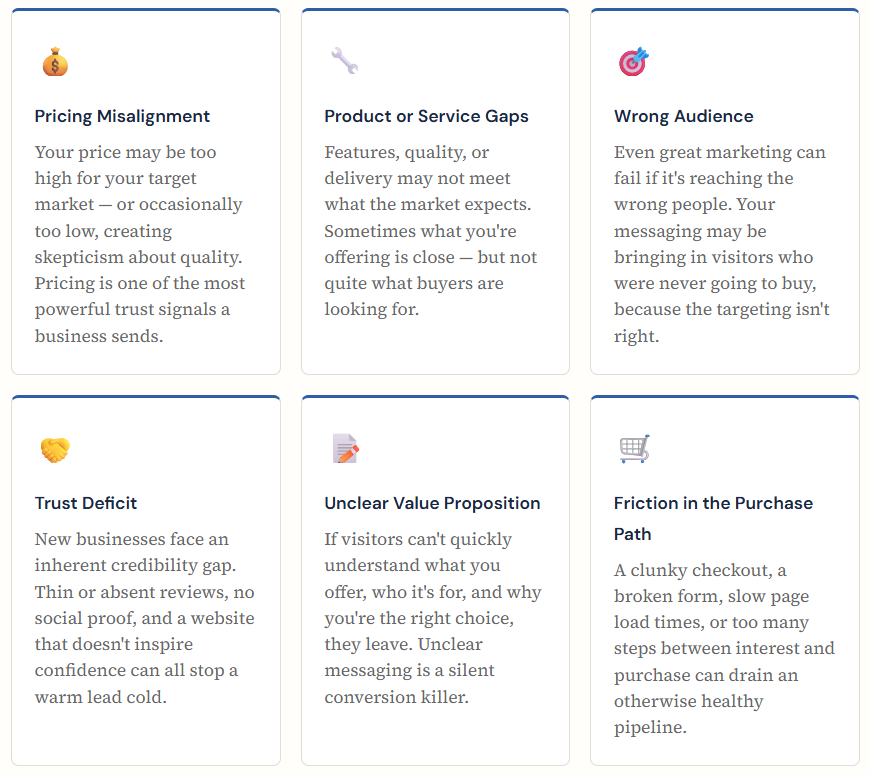
If your marketing is genuinely generating visibility — people are finding you, visiting your site, inquiring about your services — but conversion rates are low, the honest question to ask is: is this a marketing problem, or a product/service problem?
Marketing's job is to bring the right people to you. Your product or service's job is to earn their trust and their purchase.
When that handoff breaks down, the causes almost always fall into one of a handful of categories:
The Right Sequence: Market, Listen, Refine, Grow
The healthiest way to think about the marketing-and-conversion cycle for a new or emerging business looks something like this:
Invest in marketing to generate visibility and traffic. Give it a real runway — at least 12 months of consistent, professional effort before drawing any conclusions about what's "working." Remember that most businesses need 18–24 months to reach consistent profitability, and 3 years to establish real market traction.
Track what happens to that traffic. Are people arriving at your site? Submitting inquiries? Adding things to a cart and abandoning? Each behavior tells a different story about where the breakdown is happening.
If traffic is solid but conversion is weak, investigate the product side. Let us create an anonymous survey or focus group for you. Don’t bother asking friends or family (unless you ask them to also fill out the anonymous survey). Ask the hard questions about pricing, catalog, business or product name, product fit, and the experience or service you're delivering. Don't assume the marketing is the problem just because the register isn't ringing.
Refine based on what you learn. Adjust pricing. Close feature gaps. Clarify your messaging. Improve the purchase experience. Then give the refined offering time to perform.
This iterative loop — market, listen, refine, grow — is how durable small businesses are actually built. Marketing is the engine that starts the cycle. But the fuel that sustains it is an honest, evolving understanding of what your customers actually want, and a willingness to act on it.
The Bottom Line: What Should You Plan to Spend?
Here's a simple framework based on everything the data says:
If you're pre-revenue or in your first year: Plan to invest a minimum of ~7k on marketing in year one (in our world, that’s the Standard Marketing Essentials Package). Your goal is visibility and credibility, and both take time and consistency to build.
If you're in years one to three with some revenue: Follow the SBA's guidance adapted for growth-stage businesses: allocate 10–12% of your gross revenue to marketing. That may feel uncomfortable at first, but it reflects the real cost of building a brand from scratch in a competitive market.
If you're an established business looking to grow: To actively grow (not just maintain) aim for 9–12% and make sure every dollar is deployed across a coordinated, multi-channel strategy rather than scattered across unconnected tactics.
If you’re still determiend to DIY it, remember that your time is worth money. In our experience, time and time again, DIY marketing is inconsistent at best. A good professional agency delivers more, faster, more effectively, and almost always for less than the fully loaded cost of a single in-house hire.
Ready to Build a Marketing Plan That Fits Your Budget?
Schedule your free, zero-pressure consultation with Austen Agency. We'll walk through your goals, your current situation, and what a smart, affordable marketing investment looks like for your business.
Schedule Your Free Consultation
Austen Agency is a web design and digital marketing agency serving small businesses, solopreneurs, and growing brands.
Sources & References
U.S. Small Business Administration — How to Get the Most From Your Marketing Budget (sba.gov)
Intuit — Small Business Marketing Budget Estimates (2025)
Deloitte / Duke University — The CMO Survey, 2025
WebFX — Small Business Marketing Budget Statistics (2024–2025)
RevenueMemo — Small Business Marketing Budget Statistics for 2026 (revenuememo.com)
TrueFuture Media — How Much Should a Growing Business Spend on Marketing in 2026?
The Manifest — Small Business Marketing Survey (2023)
Glassdoor — Digital Marketing Specialist Salary Data (2025)
MarketerHire — Agency vs. In-House Cost Analysis (2025)
Litmus — Email Marketing ROI Statistics (2024)
Content Marketing Institute / Forbes — Content Marketing Lead Generation Benchmarks
Wordsteam
Fact Company